Introducing the arboriculture and urban forestry profession to the next generation has been a growing conversation, and one of the first steps is creating opportunities for connection.
During last month’s North American Tree Climbing Championship (NATCC), a group of high school students from Washington, D.C., attended the tree climbing competition as part of the Native Tree Farm and Research program. This program is a nonprofit organization that introduces high school students to environmental stewardship, tree care and other aspects of the green industry.
With the group was ISA Certified Arborist® Charles Boston, who was the main lead for the program’s outing. He said the goal of attending the NATCC with these students was to help showcase this side of the arboriculture industry.
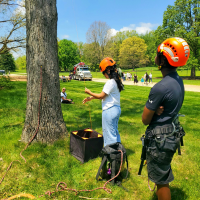
“It’s pretty cool to see a community get together,” said Lakita Wills, a student at Richard Wright Public Charter Schools. “I like the throwline event the most. It’s interesting to see how they don’t give up, even when it doesn’t go the way they want it to.”
Boston said ultimately, from this experience, he wants students to see what’s out there. A lot of people still don’t know that arboriculture is an industry with multiple career paths, tree climbing being one of many.
As such, much of the Native Tree Farm and Research’s work connects to how plants are associated with climate resiliency, cancer research, community resources and career readiness.
“The whole mission is really just to connect a new generation to the importance of tree care and environmental stewardship, where it appears it has been missed by a couple generations, and you can see that due to the lack of environmental education that we have in our school system today,” Boston said.
He added that while the hope is that students will go into the green industry, the more important goal is for each of them to learn how to be better stewards of the environment and see where their passions can align with arboriculture.
For example, Avery Malone, a student at Phelps Architecture, Construction, and Engineering High School, originally thought she wanted to go into early development and child care. However, after experiencing some of the projects with the Native Tree Farm and Research program, she now wants to go into biomedical engineering and continue to find ways to engage in tree care.
“Throughout the program, I’ve actually learned a lot,” Malone said. “When I first started, I would walk past a tree and think that the tree was perfectly healthy, but once I joined the program, I noticed when trees were dying or stressed. I learned about invasive species. I learned about plants that could kill off invasive species like the spotted lanternfly. I learned how to give tree injections. I learned about how to identify a lot of different things.”
Boston said students can find opportunities in arboriculture even in unexpected areas. Caleb Davis, a student at Richard Wright Public Charter Schools, expressed his interest in pursuing a career in aviation. Boston noted that there is a demand for aviation skills in arboriculture, particularly with remote pilots conducting aerial inspections as part of the tree care process after storms.
Meanwhile, Wills is interested in cosmetology. Boston said they are connecting her future field to tree biology, physiology and various plant species that can be used in cosmetic products. Wills highlighted that plants like English Ivy can even be incorporated into soap-making.
But this goes beyond students’ individual career aspirations because tree care affects the community at large.
“A tree is a living organism,” Boston said. “It’s just like a child, and so a new tree is like a new baby, it needs attention so it can grow strong.”